
Holding Time in a Single Frame
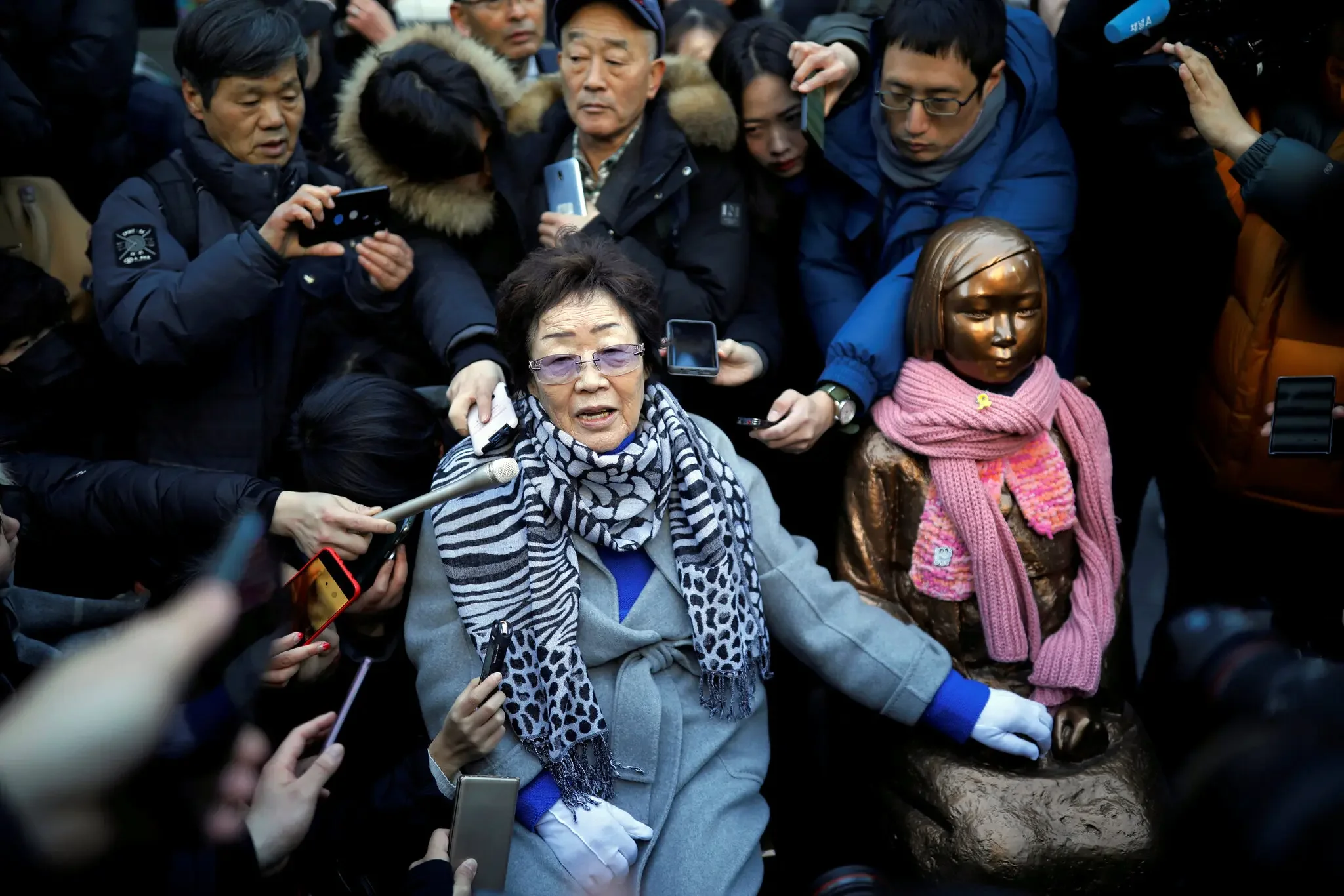
⏶ Photo by Kim Hong-Ji/Reuters, published in The New York Times, 2019.
A woman is holding the hand of a statue, sitting side by side, staring forward. Around her, the crowd is restless, busy, almost unable to stop moving–cameras lifted, gazes fixed, attention narrowing toward the same center: her. Hands with microphones reach into the frame from every direction, closing in around her face. Smartphones hover near her mouth, as if her speaking voice might vanish unless it is captured. Bodies press together in a quiet chaos of looking.
Her name is Lee Yong-soo, one of only six surviving “comfort women” still alive in South Korea–one of the estimated 200,000 innocent girls who were forced to the Japanese Brothel as military sex slaves for thirteen years. Next to her sits the Statue of Peace: a young girl cast in copper, created to remember the “comfort women,” her neck wrapped in a pink hand-knitted scarf as if she were alive, as if warmth could still be offered back across time.
Eighty-one exact years have passed since Korea’s liberation from Japanese colonialization, but in Lee Yong-soo’s life, the past has never fully loosened its grip. She was only sixteen when she was taken, pulled into a system of wartime sexual violence long masked by the euphemistic term “comfort women.” Now, at ninety-two, she sits beside a statue cast as a girl, frozen in the age she once was when that violence began. Time has moved forward in her body–wrinkles deepening, years accumulating–but the figure next to her remains permanently paused, holding history at its point of rupture. The photograph captures this strange coexistence: one life continuing into old age, and another moment of girlhood suspended forever, held in public view as memory becomes something seen, recorded, and carried forward.
Photographed by Kim Hong-Ji for Reuters and later published in The New York Times, this image carries a power beyond what it simply depicts. It is a photograph that holds the past, the present, and the future together in a single frame. At its center is Lee Yong-soo herself–a living witness–one of the few remaining survivors of Japan’s wartime system of sexual slavery, still here, still speaking. Beside her sits the Statue of Peace, a figure frozen as a young girl, holding the past in its most condensed and unbearable form: stolen girlhood, colonial violence, a life paused at the age when trauma began. And surrounding them is the present world–reporters, cameras, microphones, hands reaching inward–not only observing, but actively recording, translating testimony into media, into circulation, into what the future will inherit once the witnesses are gone.
Susan Sontag writes in On Photography that “photographs furnish evidence,” and that a photograph often “passes for incontrovertible proof that a given thing happened” (Sontag, p. 3). In other words, photographs carry a special authority: they make events feel real, undeniable, even when words alone might be doubted and ignored. In Kim Hong-Ji’s image, that authority takes on particular weight. Beyond simply accompanying a news story, the photograph insists on Lee Yong-soo’s presence, forcing the past into the frame of the present. What is so often treated as distant, disputed, or abstract becomes suddenly visible: a ninety-two-year-old woman sits beside the girl she was forced to leave behind, now frozen in copper. Here, her body becomes its own kind of testimony, and the photograph becomes a strong proof not only that this violence occurred, but that its aftermath still lives on in someone who is still surviving it.
However, Sontag also reminds us that this evidentiary power is never innocent. Even as photographs claim to document reality, they also impose a frame–a way of seeing that can shape, contain, and even claim authority over another person’s experience. She warns that “there is an aggression implicit in every use of the camera,” and that to photograph someone is to turn them into an object that can be symbolically possessed (Sontag, p. 4)—made into an image that others can hold onto, circulate, and interpret from a distance. That tension lingers quite sharply in this photographed scene, as Lee’s testimony is amplified through the lenses surrounding her, but is also shaped and filtered through them–the media reporters–unfolding under microphones and the pressure of being recorded. Once captured, her grief does not remain only hers, but becomes a public image that travels outward, received by audiences with different values, distances, and understandings of history. What we are witnessing, then, is not simply personal remembrance, but remembrance mediated: trauma entering public memory through photography’s double role as both evidence and framing. The photograph therefore proves, but also reminds us that visibility is never neutral; to be remembered through images is also to be framed by them.
The Statue of Peace beside Lee deepens this complexity by showing how remembrance becomes visual. On foresight, the copper girl might appear as a simple memorial figure–an object of commemoration placed beside a survivor. But in hindsight, the statue becomes something far heavier–what Sturken and Cartwright call an “image icon,” a form that gathers collective meaning beyond itself, carrying history in a shape that can be instantly recognized, circulated, and returned to (Sturken & Cartwright, p. 53). Cast as a young girl paused at the age when violence began, the statue condenses an entire history into a single body, of stolen girlhood, colonial trauma, and a past that remains unresolved. In this way, the photograph transforms Lee’s experience from something endured by one powerless individual into something a nation, and even a global audience, is asked to see and remember. Meaning emerges beyond what is visible at first glance: Lee’s hand resting in the statue’s hand becomes contact across time, between lived history and symbolic form, between the woman who survived into old age and the girl she was never allowed to remain. The photograph suggests that the past is not simply recalled, but embodied, made enduring through images that continue to hold what cannot be fully spoken.
In today’s world, only six survivors remain alive. Soon, living testimony will disappear, and what will endure are the visual forms that have come to stand in its place: statues, photographs, circulated icons that future generations will inherit as their way of knowing. The crowd pressing inward is not only documenting Lee’s story, but shaping the conditions under which that story will be remembered through media frames, through public attention, through images that will outlast the witness herself. At this moment, history is still speaking, but it is already being translated into representation, into what will remain once the voice is gone.
Ultimately, Kim Hong-Ji’s photograph reminds us that remembering is never neutral. To witness through a camera is also to frame, to circulate, to turn a life into something others can hold at a distance. The image preserves Lee Yong-soo’s presence, but it also shows the cost of that preservation–memory made public, grief made visible–leaving us with an unsettling question: when the witnesses are gone, what will it mean to inherit history through images alone?
Links
“A Harvard Professor Called Wartime Sex Slaves ‘Prostitutes.’ One Pushed Back.”: https://www.nytimes.com/2021/02/26/world/asia/harvard-professor-comfort-women.html
“Comfort women”: https://en.wikipedia.org/wiki/Comfort_women
“S.Korea's few surviving 'comfort women' face life's end as political fight rages on”: https://www.reuters.com/world/asia-pacific/skoreas-few-surviving-comfort-women-face-lifes-end-political-fight-rages-2021-07-02/
“The Brutal History of Japan’s ‘Comfort Women’”: https://www.history.com/articles/comfort-women-japan-military-brothels-korea
