
From Backlash to Brand Loyalty: How Balenciaga Uses Controversy as Currency for Resilience
Luxury fashion marketing is a finely tuned performance and an intricate dance between aspiration and exclusivity, where brands craft not just products but identities that evoke desire, cultural relevance, and an air of untouchable prestige. Each brand’s campaigns are not mere advertisements but bold statements designed to captivate audiences and solidify their status as cultural icons and tastemakers. But what happens when a brand’s artistic expression veers into controversy? When a brand’s narratives push too far and cross a line from provocative to inappropriate, the delicate balance between boldness and taste collapses, alienating the very consumers the brand seeks to enthrall. This tension underpins Balenciaga’s calculated use of crisis-driven storytelling—not merely as a recovery mechanism but as a means to transform controversy into an opportunity to reinforce exclusivity, deepen consumer loyalty, and redefine its cultural relevance in an increasingly skeptical digital age.
In November 2022, Balenciaga—a brand celebrated for its daring sophistication and boundary-pushing designs—faced global condemnation for its Spring 2023 holiday campaign. The campaign featured unsettling imagery, including children clutching teddy bear handbags styled in bondage gear and documents referencing child pornography laws which “juxtaposed children and featured what looked like bondage paraphernalia” (Paton, Friedman, & Testa, 2022). Known for blending high fashion with cultural commentary, Balenciaga’s reputation as a rebellious yet refined force in fashion was abruptly jeopardized. Accusations of trivializing child exploitation for shock value shattered the brand’s carefully-curated image and positioned the brand at the center of an ethical firestorm. This scandal presented Balenciaga with a monumental challenge: to navigate public outrage, rebuild consumer trust, and salvage its identity as a leader in luxury fashion.
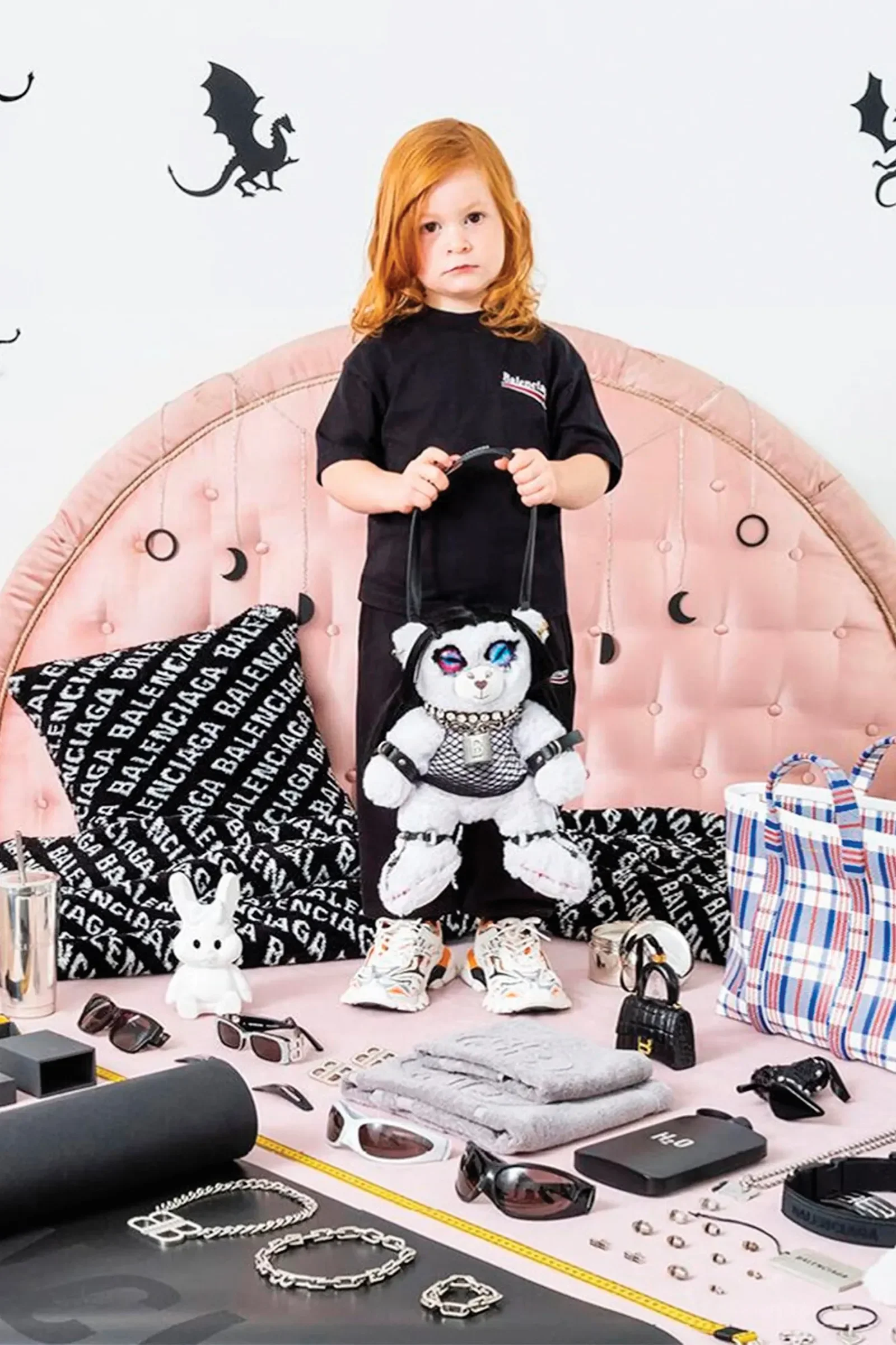
A picture from Balenciaga’s Spring 2023 Campaign. A kid model is holding a teddy bear in bondage gear. (Collins, 2023).
The repercussions of the Spring 2023 campaign backlash were swift and severe, posing a direct threat to Balenciaga’s carefully curated reputation as a forward-thinking leader in high fashion. Public outrage over the campaign’s unsettling imagery reverberated through the luxury market, and the financial impact was immediate. According to Yahoo Finance, Kering, the French conglomerate that owns the brand Balenciaga, experienced a significant drop in its stock price within a month from the stock price being approximately €560 per share on November 27, 2022, to €470 per share by mid-December—a stark indication of the reflection of consumer and investor discontent. Yet, by early January, the stock price rebounded to €565 per share, surpassing its pre-crisis value, reflecting the brand’s capacity for resilience in the time of crisis. This rebound did not happen by chance; it was the result of a deliberate and strategic response by Balenciaga to address public criticism while preserving its identity as a culturally provocative luxury house. During this time of intense crisis, the brand adopted storytelling as a key strategy, reframing the crisis as an opportunity to demonstrate accountability and evolve its narrative. By blending transparency with cultural sensitivity, Balenciaga positioned itself not only to recover but to redefine its relevance in an era of heightened consumer awareness. This calculated approach of crisis-driven storytelling revealed how, even in moments of controversy, luxury brands can transform backlash into opportunities to reinforce their exclusivity and deepen consumer loyalty, turning crises into significant chapters of innovation and reinvention.
When discussing the crisis-driven strategies of luxury brands, it is important to recognize that storytelling, once a primary tool for engagement, has evolved into a sophisticated mechanism for redefining public perception, especially during moments of backlash. In luxury branding, storytelling is not just a means of narrating a brand’s identity—it is integral to safeguarding exclusivity and reinforcing a brand’s cultural and aspirational significance in the face of controversy. As Singh (2021) states, “[l]uxury brands differentiate themselves from traditional brands based on their core values and characteristics such as exclusivity, craftsmanship, and aesthetic attributes” (p. 9). This intrinsic exclusivity, which lies at the heart of Balenciaga’s identity, makes storytelling an essential strategy for navigating crises without undermining the brand’s prestige. And during its Spring 2023 ad campaign crisis, Balenciaga demonstrated how a calculated narrative could transform backlash into an opportunity for growth, employing two primary strategies: 1) issuing public apologies and taking accountability, thereby increasing transparency with customers, and 2) reevaluating partnerships to align with ethical standards. These approaches not only allowed the brand to address immediate criticisms but also to deepen its connection with its audience, illustrating how storytelling serves as a bridge between crisis management and long-term brand resilience.
Balenciaga’s response to the Spring 2023 campaign controversy was one powerful approach that exemplified how a luxury brand can use immediate and transparent accountability to transform backlash into an opportunity for strengthening consumer trust and reinforcing its exclusivity. In the wake of widespread criticism, the brand swiftly withdrew the offending content and issued a series of public apologies within ten days of the campaign’s launch on November 16th, 2022. These apologies, shared across platforms like Instagram Stories, stood out for their direct acknowledgment of responsibility by both the corporate entity and key individuals, including Chief Creative Director, Demna. On November 28, 2022, Balenciaga released a formal house statement addressing the controversy and outlining immediate and long-term corrective actions. The statement declared,
“We deeply regret the offense caused by our recent campaign. We take full responsibility for the lack of oversight and the inclusion of unauthorized elements in the campaign imagery. To address this, we are conducting a thorough internal review of our processes to ensure stricter creative controls and accountability. Furthermore, we are initiating legal action against the parties responsible for these unapproved elements and are committed to taking all necessary steps to prevent such incidents in the future.” (Vogue, 2023, p. 100).
This statement was significant for its transparency and specificity. By using direct language such as “we deeply regret” and “we take full responsibility,” the brand communicated a clear acknowledgment of its failure to oversee the creative process, addressing consumer concerns head-on. The commitment to conducting a “thorough internal review” of its campaign-development process signaled a proactive approach to addressing systemic issues within the organization, ensuring stricter oversight and accountability in creative decisions. This commitment had an immediate impact on consumer perceptions, marking a shift in the public discourse surrounding Balenciaga’s accountability. Before the statement, public outrage was at its peak, with people saying, “[t]his is criminal & sick…sexualizing children must be a redline,” reflecting widespread disgust and a call for action (Rose, 2022). However, after the apology and the outline of corrective measures, the sentiment began to evolve. A more measured response emerged, such as one tweet reading, “I hope they mean this…Balenciaga has always been an esteemed name in fashion and this would be a sad comedown” (Patricia, 2022). These reactions highlighted a cautious optimism among consumers, indicating that Balenciaga’s transparent approach was beginning to rebuild trust, albeit tentatively. Additionally, the announcement of legal action emphasized Balenciaga’s intent to hold external contributors accountable, framing the brand as both a victim of external negligence and a responsible entity determined to prevent recurrence. These multi-stepped apologies were not just reactive but preventive, demonstrating a forward-looking strategy that combined humility with a tangible commitment to reform, aimed at regaining consumer trust while safeguarding the brand’s ethical standards. Even further, this statement set the stage for the brand’s storytelling approach, positioning the crisis not as a simple failure but as the start of a brand’s new journey toward accountability, reform, and alignment with modern ethical values.
The sequence of Balenciaga’s apologies continued to unfold with a pivotal personal statement from Chief Creative Director, Demna, on December 2, 2022, which reinforced the brand’s commitment to accountability and advancing the narrative of its crisis-driven storytelling. Building on the foundation of Balenciaga’s corporate acknowledgment, Demands apology added a layer of personal vulnerability that proved critical in regaining customer trust. In his statement, Demna candidly admitted, “I want to personally apologize for the wrong artistic choice of concept for the gifting campaign with the kids, and I take my responsibility” (Vogue, 2023, p. 100). This level of candor, rarely seen in the luxury fashion industry, reflected a heartfelt acknowledgment of fault, distinguishing and differentiating Balenciaga’s response from the often reserved or detached reactions typical in the luxury marketing industry. By explicitly acknowledging and labelling his decision as a “wrong artistic choice” and taking unequivocal ownership through phrases like “I take my responsibility,” Demna avoided deflecting blame onto external parties or the broader creative team. Instead, he humanized Balenciaga, presenting Balenciaga as a brand led by individuals capable of confronting mistakes and committing to growth. This approach sharply contrasted with traditional luxury industry norms, which often rely on stoic silence or minimalistic statements to preserve an aura of infallibility and exclusivity (Kapoor & Banerjee, 2021, p. 1049). As Gurzki et al. (2019) observe, luxury brands traditionally rely on the mystique of inaccessibility and exclusivity, which can lead to a lack of transparency during crises, alienating consumers and eroding trust (p. 412). By eschewing this reserved approach and rather embracing transparency and personal vulnerability with the global audiences, Demna determinedly disrupted the conventional luxury playbook, presenting an emotionally resonant response that bridged the gap between Balenciaga’s avant-garde, elite identity and the ethical expectations of its audience. His apology resonated with the consumers, inviting empathy and signaling a willingness to learn from errors. This layered and transformative response not only reframed the crisis narrative into one of reform and growth but also positioned Balenciaga as a progressive brand competent of balancing bold creativity with accountability. In doing so, Demna’s statement became a cornerstone of Balenciaga’s crisis-driven storytelling, illustrating how humility and transparency can reinforce consumer trust, safeguard exclusivity, and ensure a brand’s relevance in a values-driven marketplace.
This stratified response of the controversy particularly aligns closely with what Kapoor and Banerjee (2021) describe as the need for brands to actively engage with consumer concerns during crises. The two scholars in their journal article, “On the relationship between brand scandal and consumer attitudes: A literature review and research agenda” present a claim that that “silence [or passive responses] may be construed as an absence of concern for consumers” whereas direct and transparent actions “acts as a shield and mitigates reputational harm caused by a brand scandal.” (p. 1048 & 1069). Balenciaga’s dual approach—combining a corporate lens with Demna’s personal acknowledgment—effectively illustrated a deep understanding of this dynamic, leveraging the crisis as an opportunity to communicate its values and commitment to improvement. By adopting emotionally resonant apologies across multiple platforms and pairing them with actionable measures like internal reviews and legal accountability, the brand exemplified the essence of crisis-driven storytelling—a strategy where transparency, accountability, and reform are used to turn backlash into a narrative of growth and resilience. The sequence of apologies and promises painted a cohesive story of a brand that acknowledged its errors, sought to correct them, and used the crisis to emphasize its adaptability and values. This approach not only helped the brand manage the immediate fallout but also strengthened its exclusivity by showcasing its ability to adapt and align with modern consumer expectations. In an age where consumers are increasingly skeptical of corporate ethics, Balenciaga’s proactive engagement certainly allowed the brand to rebuild trust and cultivate deeper, loyalty-based relationships. Rather than allowing the controversy to erode its reputation, Balenciaga transformed the crisis into a climactic moment that reinforced its status as an innovative and forward-thinking luxury brand committed to evolve alongside its audience.
Balenciaga’s crisis-driven storytelling extended beyond public apologies by utilizing strategic partnerships, most notably with Kim Kardashian, to underscore its commitment to reform and resilience while reinforcing the brand’s exclusivity. Kardashian’s association with Balenciaga, cultivated under Creative Director Demna Gvasalia, began in 2021 and quickly became a defining element of the brand’s modern narrative. Known for his avant-garde and boundary-pushing vision, Demna strategically aligned Kardashian’s global influence and cultural relevance with Balenciaga’s innovative and provocative aesthetic. Their partnership was solidified with her dramatic appearance at the 2021 Met Gala, where she donned an all-black ensemble that fully obscured her face—an unprecedented look that sparked widespread media discussion and cultural fascination. This bold statement generated nearly 2.5 million likes on Instagram and $935,000 in media impact value (Wynne, 2022), showcasing the power of Kardashian’s star presence to elevate Balenciaga’s visibility and amplify its reach. Beyond singular moments, Kardashian seamlessly integrated Balenciaga into her personal brand, frequently appearing in the label’s designs and using her platform to promote its aesthetic to her vast audience. This relationship bridged the gap between elite luxury and mainstream accessibility, appealing to younger, digitally savvy consumers while maintaining the brand’s exclusivity. As Gurzki et al. (2019) note, celebrity endorsements imbue luxury brands with symbolic value by linking them to aspirational lifestyles and enhancing cultural resonance (p. 409). Kardashian exemplified this dynamic by transforming her personal style into a cultural movement deeply tied to Balenciaga, making her partnership with the brand not just a marketing collaboration but a mutual elevation of identity and relevance. This strategic alignment allowed Balenciaga to adapt to evolving consumer expectations, ensuring its continued status as a forward-thinking luxury brand in a competitive, values-driven marketplace.
However, the Spring 2023 campaign controversy posed a significant threat to Balenciaga’s carefully curated partnership with Kim Kardashian, as the backlash over its inappropriate imagery demanded immediate accountability from both the brand and its ambassadors. Kardashian, known for her role in elevating Balenciaga’s cultural relevance and aspirational appeal, faced immense public scrutiny due to her association with the brand. As a globally recognized figure with over 360 million Instagram followers, Kardashian was compelled to publicly distance herself to protect her personal reputation and avoid being seen as complicit in a controversy involving sensitive issues like child exploitation. In a strongly worded statement, Kardashian expressed her shock and disappointment, declaring, “As a mother of four, I was shaken by the disturbing images. The safety of children must be held with the highest regard, and any attempts to normalize child abuse have no place in society—period” (Kim Kardashian, 2022). She further stated that she was “reevaluating” her relationship with Balenciaga, a declaration that strongly resonated with a public demanding ethical accountability and tangible reform from the brand. The impact of her statement was evident almost immediately; Kering’s stock price dropped by 100 euros in just two weeks, highlighting the significant influence Kardashian wielded over consumer sentiment and investor confidence. This temporary distancing placed immense pressure on Balenciaga to enact meaningful changes, as Kardashian’s critique underscored the critical role she played as an ambassador capable of shaping consumer trust and loyalty. As Kapoor and Banerjee (2021) emphasize, partnerships during crises are pivotal, as brands are judged by their ability to align their actions with public values to retain consumer trust (p. 1054). Recognizing Kardashian’s indispensability, Balenciaga embarked on a calculated strategy to reconcile their relationship, turning the crisis into an opportunity to demonstrate reform and strengthen its brand narrative.
Balenciaga’s reconciliation with Kardashian was more than damage control; it was a deliberate component of its crisis-driven storytelling, utilizing the partnership to rebuild trust and reaffirm the brand’s exclusive status as a top luxury fashion label. Beyond issuing public apologies, Balenciaga implemented significant internal reforms to demonstrate its commitment to change. These included establishing stricter oversight protocols for creative campaigns, forming an internal task force to ensure ethical compliance, and initiating a partnership with the national association to support social advocacies, specifically about child protection initiatives. These actions addressed the public’s concerns about the brand’s ethical lapses and underscored its efforts to reform not only its practices but also its corporate values. These reforms laid the groundwork for Kardashian’s eventual return to the brand as a renewed ambassador in early 2024. Her re-engagement, marked by her prominent appearance in Balenciaga’s campaigns featuring iconic pieces such as the Le Cagole and Hourglass bags, was carefully orchestrated to symbolize mutual accountability and growth. Kardashian’s return served as a powerful visual testament to Balenciaga’s redemption narrative, signaling that the brand had taken substantive steps to address its missteps. As Lee et al. (2024) assert, “When individuals are transported into a story, they can empathize with the characters, even if those characters have different values or appearances” (p. 3). Partnerships with influential figures enable brands to navigate crises by crafting narratives of adaptability and accountability, aligning brand values with consumer expectations (p. 9). Kardashian’s reappearance exemplified this principle, as her return to the brand validated the effectiveness of Balenciaga’s reforms and lent credibility to its renewed commitment to ethical standards. Her endorsement sent a strong message to her 360 million Instagram followers and beyond that Balenciaga had actively worked to rectify its faults, presenting a brand worthy of continued support. By choosing to re-associate herself with Balenciaga after its reforms, Kardashian not only amplified its redemption arc but also bridged the gap between the brand’s prior controversies and its aspirations for a more ethically responsible future. This seamless reconciliation allowed Balenciaga to reintegrate Kardashian into its storytelling, leveraging her unparalleled influence to reinforce its cultural relevance and rebuild consumer trust. Her involvement became a cornerstone of the brand’s crisis-driven narrative, transforming a potentially devastating controversy into an opportunity for growth, resilience, and strengthened exclusivity. This strategic partnership ultimately underscored Balenciaga’s ability to adapt and evolve, ensuring its continued relevance in a skeptical luxury market where authenticity, transparency, and ethical accountability are increasingly valued.
Another partnership—Balenciaga’s collaboration with the National Children’s Alliance (NCA)—marked a transformative milestone in its over-century-long history, emphasizing the brand’s strategic use of partnerships to navigate the aftermath of the Spring 2023 campaign controversy. On February 8, 2023, Balenciaga and the Kering Foundation announced a three-year partnership with the NCA, focusing on key areas of child protection and trauma recovery, a move that signaled a deliberate shift toward ethical accountability and corporate responsibility (Balenciaga, 2023). This partnership included several impactful measures: funding the expansion of the NCA’s Mental Health Institute to increase access to Trauma-Focused Cognitive Behavioral Therapy (TF-CBT), training nearly 2,000 professionals specialized in child abuse, and enabling up to 55,000 children to receive evidence-based mental healthcare over three years. TF-CBT, which has been proven to reduce symptoms of Post-Traumatic Stress Disorder (PTSD), anxiety, depression, and behavioral issues, provides children with critical tools to process traumatic experiences and equips caregivers with strategies to support their recovery (Balenciaga, 2023). These efforts addressed systemic issues brought to light during the Spring 2023 controversy, reflecting Balenciaga’s intention to create a lasting positive impact beyond the immediate crisis. Additionally, the partnership included public awareness campaigns to educate communities about child abuse prevention and internal training programs for Balenciaga employees on child protection and advocacy, ensuring these principles became embedded in the brand’s operations and values. As CEO of Balenciaga, Cédric Charbit explained, the initiative was informed by a “listening tour” where Balenciaga engaged with experts in childhood trauma, deepening its understanding of the issue and strengthening its resolve to contribute meaningfully to children’s well-being (Balenciaga, 2023). By aligning their brand values with a nationally recognized organization such as the NCA, Balenciaga added a layer of moral gravitas to its brand story, signaling authenticity and a willingness to address significant societal challenges. This collaboration, coupled with internal reforms, redefined Balenciaga’s identity as a brand committed to ethical reform while balancing high fashion with meaningful action. As Lee et al. (2024) note, partnerships with credible advocacy organizations provide brands with cultural authority and transform crises into opportunities for impactful action (p. 8). Balenciaga, by integrating the NCA’s mission into their brand narrative, demonstrated that a brand could maintain its exclusivity while addressing the values of a socially conscious audience. These actionable steps not only addressed immediate consumer concerns but reframed the controversy as a testament to Balenciaga’s adaptability and progress, positioning the brand as a leader in ethical luxury. This alignment allowed Balenciaga to move beyond mere apology, transforming the controversy into a testament to its commitment to innovation, integrity, and aspirational allure in an increasingly ethical global market.
Ultimately, Balenciaga’s response to the Spring 2023 campaign controversy serves as a great precedent that demonstrates the transformative power a crisis-driven storytelling possesses in luxury branding. By leveraging strategies rooted in transparency, accountability, and ethical alignment—and recognizing the crucial role of digital platforms and influencers in shaping public perception—Balenciaga navigated a reputational crisis with remarkable agility. Through public apologies, reconciled relationships with influential figures like Kim Kardashian, and groundbreaking partnerships such as the collaboration with the National Children’s Alliance, the brand turned a moment of intense scrutiny into an opportunity to deepen its connection with a modern, socially conscious audience. This calculated use of storytelling allowed Balenciaga not only to address immediate criticisms but also to redefine itself as a culturally and ethically progressive luxury brand, transforming backlash into a pivotal chapter of growth and renewed exclusivity.
Looking ahead, Balenciaga’s response offers a valuable insight: scandals and crises, inevitable in both personal and organizational journeys, need not mark the end. Instead, when approached with humility, strategic thinking, and a commitment to reform, these moments can serve as catalysts for reinvention and strength. In the digital age, where every misstep is amplified under a global lens, the ability to craft a narrative of redemption and innovation becomes not just a survival strategy but a pathway to greater resilience and authenticity. Balenciaga’s journey underscores the potential for mistakes, when handled thoughtfully, to pave the way for stronger, more enduring identities. This case exemplifies how luxury brands—and individuals alike—can transform errors into opportunities to rebuild trust, foster growth, and emerge better aligned with the evolving values of their audiences.
References
Balenciaga, & The NCA. (2023, February). NATIONAL CHILDREN'S ALLIANCE. Balenciaga. Retrieved from https://www.balenciaga.com/en-us/national-children-s-alliance?srsltid=AfmBOoo_eqU8uGWgOK7e9CbszhCUvlaCdWh6W3-_C9qkFSOqBdkrYUjh
Collins, L. (2023, March). The button-pushing impresario of balenciaga. The New Yorker Magazine. Retrieved from https://www.newyorker.com/magazine/2023/03/27/balenciagas-button-pusher
Gurzki, H., Schlatter, N., & Woisetschläger, D. M. (2019, August-September). Crafting Extraordinary Stories: Decoding Luxury Brand Communications (Vol. 48 Issue 4, p. 401-414). Journal of Advertising, 401-413. https://web.p.ebscohost.com/ehost/pdfviewer/pdfviewer?vid=0&sid=c41eb69f-6e63-4cad-b82a-6e7c157d1291%40redis
Kapoor, S. & Banerjee, S. (2021, September). On the Relationship between Brand Scandal and Consumer Attitudes: A Literature Review and Research Agenda. International Journal of Consumer Studies. 1047-1078. https://onlinelibrary.wiley.com/doi/epdf/10.1111/ijcs.12633
KER.PA. (2022-2023, November 27 - January 8). Kering SA [Stock quote and chart]. Retrieved December 9, 2024 from https://finance.yahoo.com/quote/KER.PA/chart/#eyJs
Kim Kardashian. [@KimKardashian]. (2022, November 27). As for my future with Balenciaga, I am currently re-evaluating my relationship with the brand, basing it off their willingness to accept accountability for something that should have never happened to begin with — & the actions I am expecting to see them take to protect children. [Post]. X. https://x.com/KimKardashian/status/1597029753172918272?lang=en
Lee, M. (2024, July). Kim Kardashian serves blonde ambition with Platinum Curls and carries a $5k bag in Balenciaga’s new campaign. People. Retrieved from https://people.com/kim-kardashian-serves-blonde-ambition-in-platinum-curls-balenciaga-campaign-8680460?utm
Lee, Z., Syed Alwi, S. F., & Gambetti, R. (2023, August). The thousand faces of beauty: How credible storytelling unlocks disability representation in inclusive luxury fashion branding (Vol. 181). Journal of Business Research, 1-9. https://www.sciencedirect.com/science/article/pii/S0148296324002480
Lila Grace Rose. [@LilaGraceRose] (2022, November 21). This is absolutely disgusting. Balenciaga features toddlers in ads, holding teddy bears in bondage outfits and with a court document about “child porn” partially hidden in the image. This is criminal & sick. Sexualizing children must be a redline. @KimKardashian - speak out now. [Post]. X. https://x.com/LilaGraceRose/status/1594852654785536000
Paton, E., Friedman, V, & Testa, J. (2022, November). When High Fashion and QAnon Collide. New York Times (Online) New York Times Company. https://www.proquest.com/docview/2740588076/fulltext/459425C72D164DA7PQ/1?accountid=9 703&sourcetype=Blogs,%20Podcasts,%20&%20Websites
Singh, S. (2021, February). Luxury and Fashion Marketing: The Global Perspective (1st ed.). Taylor & Francis Group, 5-16 & 66-73. https://ebookcentral.proquest.com/lib/brandeis-ebooks/detail.action?docID=6373383
Wintour, A. (-). (2023, April). Demna On The Record. (Vol. 213, Number 3, pp. 100-). Vogue, Conde Nast Publications, Inc. Retrieved from https://www.proquest.com/magazines/demna-on-record/docview/2801863799/se-2
Wynne, A. (2022, November 29). Kim kardashian 'reevaluating' relationship with balenciaga: Women's Wear Daily. Wwd, 2. Retrieved from https://www.proquest.com/trade-journals/kim-kardashian-reevaluating-relationship-with/docview/2747587698/se-2
